Academic Organizations

Academic Organizations (Academic Orgs) help us organize academic activities. Academic Orgs can represent colleges, schools, departments, divisions, center, and institutes. They typically consist of faculty members and academic staff, and sometimes students. They help us organize academic activities, manage academic staffing, support curriculum planning and maintain academic records. They are not used to establish business processes. Academic Orgs reflect the structure of the academic side of our institution. They are separate from our UF administrative or operational structures.
Academic Appointments
Academic Appointments are the formal titles that define a faculty member’s role at UF. Within Workday, Academic Appointments track the individual’s academic role, such as their faculty title, tenure status, rank, affiliated academic unit and employment timeline.
Academic Appointments are not positions or jobs, and they are not connected to compensation or payroll. Lastly, Academic Appointments do not automatically update when the faculty member changes their position or job.
Example of Academic Appointment in Workday
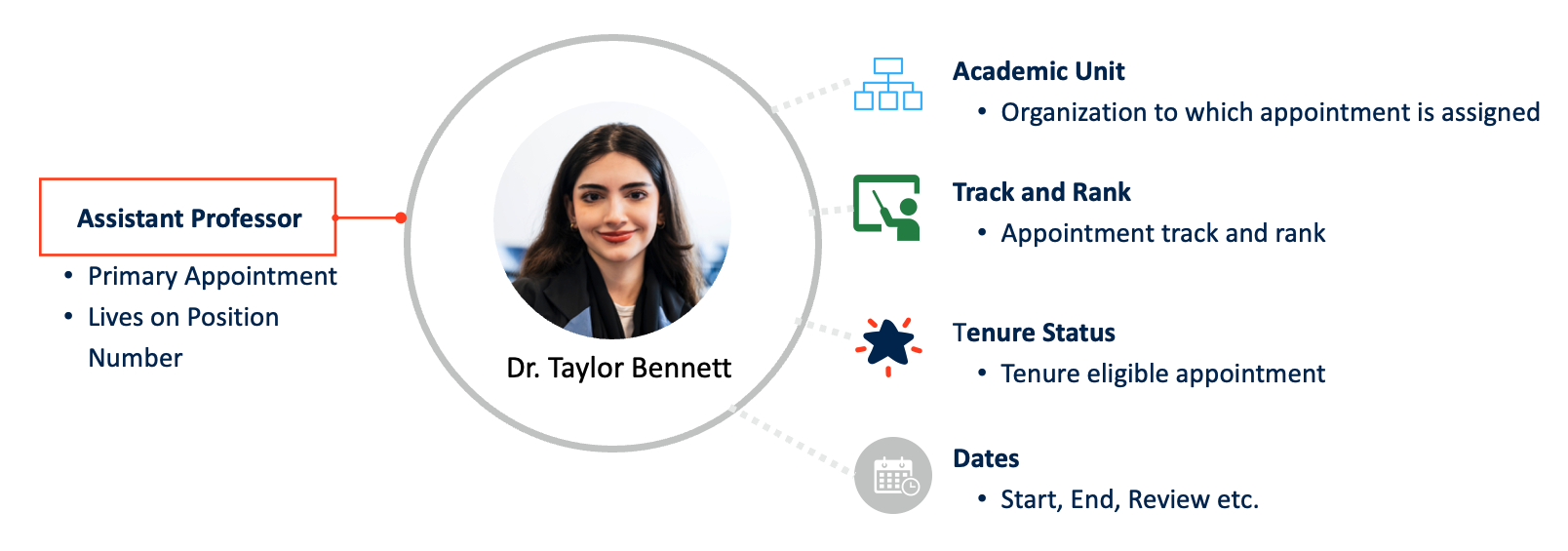
Dr. Taylor Bennett is a new faculty member at UF. The diagram below defines her academic appointment within Workday. On the left, her primary appointment is assistant professor. This primary appointment is tied to a position number, which establishes her compensation. On the right, you see the details of her academic appointment describing her academic relationship with the institution.
Dr. Bennett’s Academic Unit is the college or department to which her appointment is assigned. Track and Rank indicate her appointment’s tenure or clinical track and her rank, such as Assistant or Associate Professor. Tenure Status shows if her appointment is tenure-eligible. Lastly, important Dates are featured, including start, end and review periods.